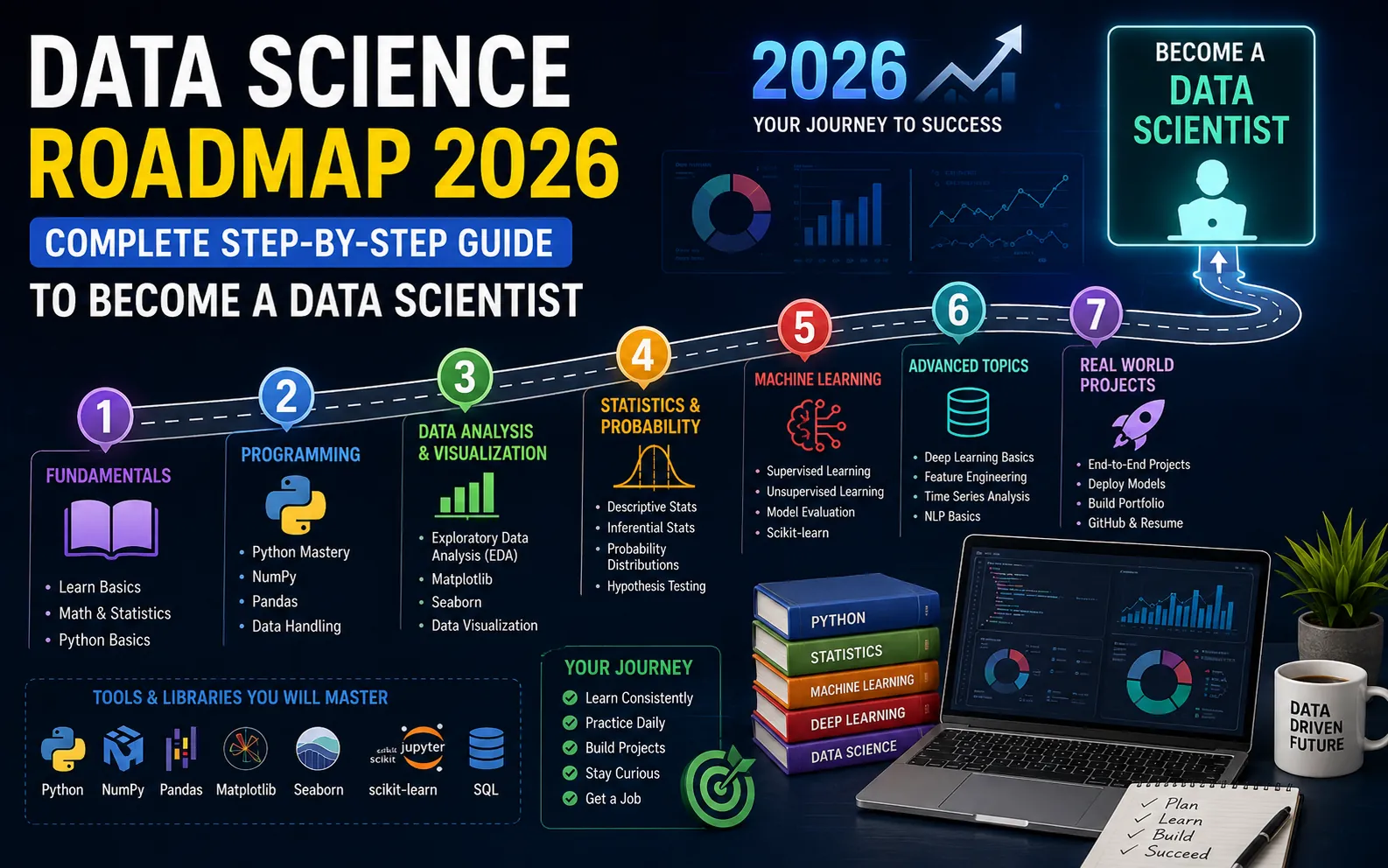
Data Science Roadmap 2026: Complete Step-by-Step Guide to Become a Data Scientist
Master Data Science in 2026 with this complete step-by-step roadmap. Learn Python, SQL, Statistics, Machine Learning, Deep Learning, and MLOps with free resources, hands-on projects, and salary insights.
Learning Path
Follow these steps in order to master the skill
Before You Start
Basic programming knowledge (any language)
High school mathematics (algebra, probability)
Curiosity and problem-solving mindset
Step 1Learn Python Programming
3 weeks
Learn Python Programming
"Master Python fundamentals including data types, loops, functions, OOP, and libraries like NumPy and Pandas. Complete at least 50 coding exercises.
Step 2Master Statistics & Probability
2 weeks
Master Statistics & Probability
Learn descriptive and inferential statistics, probability distributions, hypothesis testing, and statistical significance. Apply concepts using Python.
Step 3Become Proficient in SQL
3 weeks
Become Proficient in SQL
Master SQL queries, JOINs, window functions, subqueries, and database design. Practice on HackerRank and LeetCode SQL problems daily.
Step 4Data Analysis with Pandas & Visualization
4 weeks
Data Analysis with Pandas & Visualization
Perform EDA on real datasets from Kaggle. Create stunning visualizations with Matplotlib and Seaborn. Build an interactive dashboard with Plotly.
Step 5Machine Learning Fundamentals
8 weeks
Machine Learning Fundamentals
Learn supervised (regression, classification) and unsupervised (clustering) algorithms. Implement models using Scikit-learn. Understand model evaluation metrics.
Step 6Deep Learning & Neural Networks
6 weeks
Deep Learning & Neural Networks
Build neural networks with TensorFlow and PyTorch. Implement CNN for image classification and RNN/LSTM for text analysis. Train models on GPU.
Step 7MLOps & Model Deployment
4 weeks
MLOps & Model Deployment
Learn Docker, create APIs with FastAPI, deploy models to AWS/GCP. Implement CI/CD pipelines for ML models. Use MLflow for experiment tracking.
Step 8Build Portfolio & Job Preparation
3 weeks
Build Portfolio & Job Preparation
Complete 3 end-to-end projects, participate in Kaggle competitions, optimize your LinkedIn and GitHub profiles, and practice interview questions.
Skills You'll Master
10 skills you'll acquire through this roadmap
About This Roadmap
Why Become a Data Scientist in 2026?
Data Science remains one of the highest-paying and most in-demand careers in 2026. With companies generating 2.5 quintillion bytes of data daily, skilled data scientists are needed more than ever. A fresher data scientist in India earns ₹8-15 lakh per annum, while experienced professionals command ₹30-80 lakh+.
This comprehensive roadmap will take you from absolute beginner to job-ready data scientist in 8-12 months with structured learning and hands-on projects.
Data Science Roadmap 2026 Overview
| Phase | Topics | Duration | Key Projects |
|---|---|---|---|
| Phase 1: Foundations | Python, Statistics, SQL | 6-8 weeks | Data analysis report, SQL queries portfolio |
| Phase 2: Data Analysis | Pandas, NumPy, Matplotlib, Seaborn | 4-6 weeks | Exploratory Data Analysis (EDA) on real datasets |
| Phase 3: Machine Learning | Scikit-learn, Regression, Classification, Clustering | 8-10 weeks | Predictive models, customer segmentation |
| Phase 4: Deep Learning | TensorFlow, PyTorch, Neural Networks, CNN, RNN | 6-8 weeks | Image classifier, sentiment analysis |
| Phase 5: MLOps & Deployment | Docker, Flask/FastAPI, AWS/GCP, MLflow | 4-6 weeks | Deploy ML model as API, CI/CD pipeline |
| Phase 6: Job Preparation | Portfolio, Resume, Interview Prep, Kaggle | 2-4 weeks | Kaggle competition, capstone project |
Phase 1: Foundations Python, Statistics & SQL
Python Programming (3 weeks)
Python is the undisputed king of data science. Focus on these topics:
- Variables, Data Types, Loops, Functions
- List Comprehension, Lambda Functions
- File Handling, Error Handling
- OOP basics (Classes, Objects, Inheritance)
Statistics & Probability (2 weeks)
- Descriptive Statistics (Mean, Median, Mode, Standard Deviation)
- Inferential Statistics (Hypothesis Testing, p-value, Confidence Intervals)
- Probability Distributions (Normal, Binomial, Poisson)
- Bayes' Theorem and its applications
SQL for Data Science (3 weeks)
SQL is non-negotiable for data scientists. Master these:
- SELECT, WHERE, JOINs (INNER, LEFT, RIGHT, FULL)
- GROUP BY, HAVING, Aggregate Functions
- Window Functions (ROW_NUMBER, RANK, LAG, LEAD)
- Subqueries, CTEs (Common Table Expressions)
- Database Design & Normalization
Free Learning Resources for Phase 1:
- Python: W3Schools Python, CodeWithHarry (YouTube)
- Statistics: Khan Academy Statistics
- SQL: SQLBolt, HackerRank SQL
Phase 2: Data Analysis & Visualization
Pandas & NumPy (3 weeks)
These libraries are the backbone of data manipulation in Python:
- DataFrames, Series, Reading/Writing CSV, Excel, JSON
- Data Cleaning (handling missing values, duplicates, outliers)
- GroupBy, Pivot Tables, Merging & Joining DataFrames
- NumPy Arrays, Vectorization, Broadcasting
Data Visualization (2 weeks)
- Matplotlib: Line plots, Bar charts, Histograms, Scatter plots
- Seaborn: Heatmaps, Pair plots, Box plots, Violin plots
- Plotly: Interactive visualizations and dashboards
Data Science is 80% data preparation and 20% modeling. Master Pandas and data cleaning before jumping into ML algorithms this will save you months of frustration.
Andrew Ng, Co-founder of Coursera & DeepLearning.AI
Phase 3: Machine Learning The Core
Supervised Learning (4 weeks)
- Linear Regression, Logistic Regression
- Decision Trees, Random Forest
- Support Vector Machines (SVM)
- K-Nearest Neighbors (KNN)
- Model Evaluation (Accuracy, Precision, Recall, F1, ROC-AUC)
Unsupervised Learning (2 weeks)
- K-Means Clustering, Hierarchical Clustering
- DBSCAN, Principal Component Analysis (PCA)
- Dimensionality Reduction techniques
Ensemble Methods & Advanced ML (2 weeks)
- Gradient Boosting (XGBoost, LightGBM, CatBoost)
- Stacking, Bagging, Cross-Validation
- Hyperparameter Tuning (GridSearchCV, RandomizedSearchCV)
ML Learning Resources:
- Scikit-learn Docs: scikit-learn.org
- ML Course (Free): Andrew Ng's Machine Learning
- Kaggle: kaggle.com/learn
Data Science Salary Guide 2026 (India)
| Role | Fresher (0-1 yr) | Mid-Level (2-5 yrs) | Senior (5+ yrs) | Key Skills |
|---|---|---|---|---|
| Data Analyst | ₹5-8 LPA | ₹10-18 LPA | ₹20-35 LPA | SQL, Excel, Tableau/Power BI |
| Data Scientist | ₹8-15 LPA | ₹18-35 LPA | ₹40-80 LPA | Python, ML, Statistics, SQL |
| ML Engineer | ₹10-18 LPA | ₹20-40 LPA | ₹50-1Cr+ | ML, MLOps, Cloud, Docker |
| AI Research Scientist | ₹15-25 LPA | ₹30-60 LPA | ₹70-1.5Cr+ | Deep Learning, Research Papers |
Phase 5: MLOps & Deployment
In 2026, knowing how to deploy models is what separates good data scientists from great ones:
- Flask/FastAPI for creating REST APIs
- Docker for containerization
- Streamlit/Gradio for quick ML demos
- AWS SageMaker, Google Vertex AI for cloud deployment
- MLflow for experiment tracking and model registry
- Git for version control
MLOps Resources:
- MLflow Docs: mlflow.org
- FastAPI Tutorial: fastapi.tiangolo.com
Conclusion
Data Science in 2026 is more accessible than ever. Follow this roadmap consistently, build 15-20 projects, maintain a strong GitHub profile, and participate in Kaggle competitions. Within 8-12 months of dedicated effort, you can land a high-paying data science job. The key is consistent practice and project-based learning.
Recommended Resources
Curated materials to accelerate your learning
Frequently Asked Questions
Common questions about Data Science Roadmap 2026: Complete Step-by-Step Guide to Become a Data Scientist
01How long does it take to become a data scientist?
02Can I become a data scientist without a degree?
03What is the salary of a data scientist in India?
04Is Python enough for data science?
Learner Reviews
Share your learning experience