
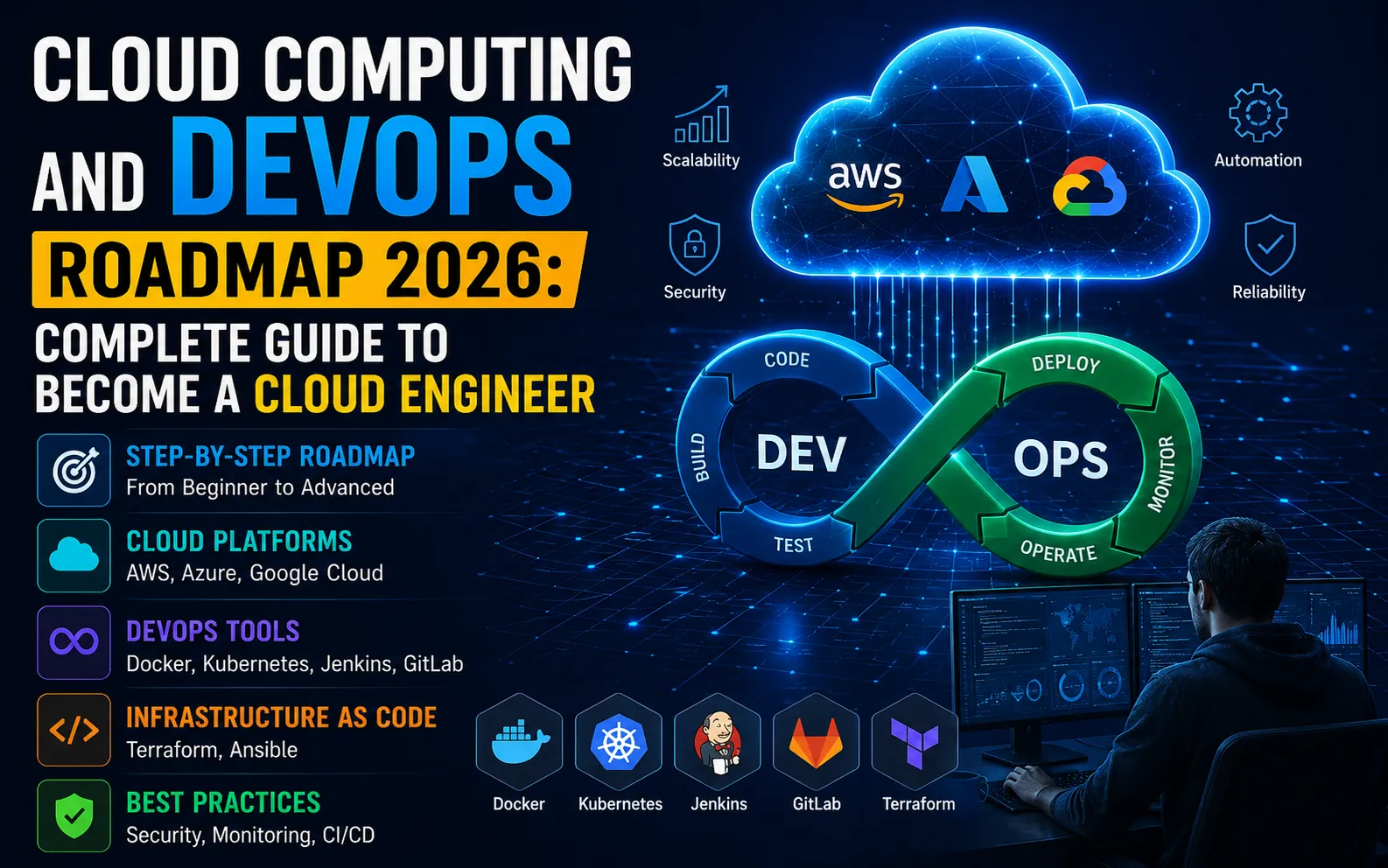
Cloud Computing and DevOps Roadmap 2026: Complete Guide to Become a Cloud Engineer
Become a Cloud and DevOps Engineer in 2026. This complete roadmap covers AWS, Docker, Kubernetes, Terraform, Jenkins, CI/CD pipelines, monitoring and more. Includes free learning resources, certification paths and real salary data.
Learning Path
Follow these steps in order to master the skill
Before You Start
Basic computer proficiency
Willingness to use the command line extensively
A computer with at least 8GB RAM for running virtual machines and containers
No prior programming experience required, but helpful
Step 1Build Your Linux and Networking Foundation
4 weeks
Build Your Linux and Networking Foundation
Install Ubuntu, learn the command line inside and out, understand file systems, permissions, process management, and shell scripting. Master networking basics: IP addressing, DNS, HTTP protocols, and firewalls. This phase is the foundation everything else builds upon. Do not skip it.
Step 2Master AWS Core Services
6 weeks
Master AWS Core Services
Create an AWS free tier account. Learn EC2 for virtual servers, S3 for storage, VPC for networking, IAM for security, RDS for databases, and Lambda for serverless computing. Deploy a complete web application on AWS using these services working together. Understanding how these pieces connect is more important than memorizing individual services.
Step 3Learn Docker and Containerization
4 weeks
Learn Docker and Containerization
Understand what containers are and why they revolutionized software deployment. Learn to write Dockerfiles, build images, manage containers, use Docker Compose for multi-container apps, and work with Docker Hub. Containerize a real application with multiple services communicating with each other.
Step 4Deep Dive into Kubernetes
8 weeks
Deep Dive into Kubernetes
This is the longest and most challenging phase. Learn Pods, Services, Deployments, ConfigMaps, Secrets, Ingress, Persistent Volumes, and Helm charts. Set up a Kubernetes cluster from scratch, deploy applications, configure auto-scaling, and implement rolling updates. Practice with minikube locally before moving to managed Kubernetes services like EKS.
Step 5Infrastructure as Code with Terraform
4 weeks
Infrastructure as Code with Terraform
Stop clicking around in the AWS console. Learn to provision entire cloud environments using Terraform. Write HCL code to create VPCs, subnets, EC2 instances, EKS clusters, and RDS databases. Learn state management, modules, and Terraform Cloud for team collaboration. The goal is that you can destroy and recreate your entire infrastructure with a single command.
Step 6Build CI/CD Pipelines
4 weeks
Build CI/CD Pipelines
Automate everything. Set up GitHub Actions or Jenkins to automatically test code when developers push, build Docker images, run security scans, and deploy to Kubernetes. Learn about different deployment strategies like blue-green and canary deployments. A proper CI/CD pipeline is what separates hobby projects from professional software delivery.
Step 7Implement Monitoring and Observability
3 weeks
Implement Monitoring and Observability
You cannot fix what you cannot see. Set up Prometheus for metrics collection, Grafana for dashboards, and Loki for log aggregation. Configure alerts that notify you when things go wrong. Learn to read dashboards and troubleshoot production issues using monitoring data. This skill alone can make you invaluable to any team.
Skills You'll Master
10 skills you'll acquire through this roadmap
About This Roadmap
Why Cloud Computing Skills Are Non Negotiable in 2026
Let me start with a number that should grab your attention. 94% of enterprises worldwide now use cloud computing in some form. Another number: cloud engineers and DevOps professionals are seeing salary hikes of 25-40% when switching jobs. The demand is absolutely insane right now.
I spoke with three hiring managers last week at major tech companies in Bangalore. All three said the same thing. They have open positions for cloud engineers that have been sitting unfilled for months. Not because there aren't applicants. Because most applicants don't have the right hands on skills.
This roadmap is designed to solve exactly that problem. It will take you from knowing nothing about cloud computing to being a job ready cloud and DevOps engineer. And yes, you can do this without a computer science degree.
The Complete Cloud and DevOps Learning Path
| Phase | What You Will Learn | Duration | Hands On Projects | Market Value |
|---|---|---|---|---|
| Phase 1 | Linux, Networking, Scripting Basics | 4 weeks | Bash scripts, network configuration | Foundation |
| Phase 2 | AWS Core Services (EC2, S3, VPC, IAM) | 6 weeks | Host a full website on AWS | $60K-$80K jobs |
| Phase 3 | Docker and Container Fundamentals | 4 weeks | Containerize a microservices app | $70K-$90K jobs |
| Phase 4 | Kubernetes and Orchestration | 8 weeks | Deploy and scale a K8s cluster | $90K-$120K jobs |
| Phase 5 | Infrastructure as Code (Terraform) | 4 weeks | Provision full AWS infra with code | $100K-$130K jobs |
| Phase 6 | CI/CD Pipelines and Automation | 4 weeks | Build a complete deployment pipeline | $110K-$140K jobs |
| Phase 7 | Monitoring, Logging and Security | 3 weeks | Set up monitoring for production apps | $120K-$160K jobs |
Phase 1: The Foundation You Cannot Skip
A lot of people try to jump straight into AWS or Docker without understanding the basics. That's like trying to build a house without a foundation. It might stand for a while, but it will eventually collapse.
Linux Mastery (2 weeks)
Every cloud server in the world runs on Linux. You need to be comfortable with the command line. Not an expert. Just comfortable. Here is what to focus on:
- File system navigation and management
- User and permission management (chmod, chown, sudo)
- Process management (ps, top, kill, systemd)
- Package management (apt, yum)
- Basic shell scripting with Bash
- SSH and remote server management
Install Ubuntu on a virtual machine or use a cheap VPS from DigitalOcean or Linode. Force yourself to do everything through the terminal. No GUI.
Networking Fundamentals (1 week)
You do not need a CCNA certification. But you absolutely must understand these concepts because everything in cloud computing builds on them:
- IP addressing, subnets, CIDR notation
- DNS and how domain resolution works
- HTTP/HTTPS protocols and status codes
- Load balancers and reverse proxies
- Firewalls and security groups
Scripting with Python or Go (1 week)
Automation is the heart of DevOps. Python is the most popular choice for cloud scripting. Focus on writing scripts that actually do useful things like automating file operations, making API calls, or parsing logs.
Free Learning Resources for Phase 1:
- Linux Journey: linuxjourney.com
- Bash Scripting Tutorial: linuxconfig.org
- Python for DevOps: realpython.com
I've hired dozens of cloud engineers over the years. The ones who succeed are not the ones with the most certifications. They're the ones who actually built things, broke things, and fixed them again. Get your hands dirty. That's the only way to learn this stuff.
Kelsey Hightower, Principal Engineer at Google Cloud and Kubernetes Legend
Phase 2: AWS Core Services
Amazon Web Services controls about 32% of the cloud market. It is the most widely used cloud platform and the best place to start your cloud journey. Here are the core services you must master:
- EC2 (Elastic Compute Cloud): Virtual servers in the cloud. Understand instance types, security groups, key pairs, AMIs, and auto scaling.
- S3 (Simple Storage Service): Object storage for files, images, backups. Learn bucket policies, versioning, lifecycle rules, and static website hosting.
- VPC (Virtual Private Cloud): Your own isolated network in AWS. Subnets, route tables, NAT gateways, and network ACLs.
- IAM (Identity and Access Management): Users, roles, policies, and permissions. This is how you secure everything in AWS.
- RDS (Relational Database Service): Managed databases. Learn to set up, connect, backup, and scale a database.
- Lambda: Serverless computing. Run code without managing servers. Perfect for automation tasks.
AWS Learning Resources:
- AWS Free Tier: aws.amazon.com/free (Use this for all your practice)
- AWS Skill Builder: skillbuilder.aws (Free courses from AWS)
- Adrian Cantrill's AWS Course: learn.cantrill.io (Best paid course, worth every rupee)
Phase 4: Kubernetes Deep Dive
Kubernetes is the most important technology in modern DevOps. It is also the most complex. Take your time here. This phase alone can take two months if you do it properly.
Start with understanding the core concepts: Pods, Services, Deployments, ConfigMaps, Secrets, Namespaces, and Ingress. Then move to practical skills like setting up a cluster from scratch, deploying applications, configuring health checks, and implementing auto scaling.
The best way to learn Kubernetes is to use it daily. Install minikube or kind on your local machine. Deploy a simple application. Break it. Fix it. Scale it up and down. Get comfortable with kubectl commands until they become muscle memory.
Kubernetes Learning Resources:
- Kubernetes Official Tutorial: kubernetes.io/docs/tutorials
- CKAD Exercises: github.com/dgkanatsios/CKAD-exercises
- TechWorld with Nana (YouTube): Best K8s tutorials for beginners
Cloud Engineer Salary Guide 2026 (India)
| Role | Fresher (0-1 year) | Mid Level (2-5 years) | Senior (5+ years) | Key Skills Required |
|---|---|---|---|---|
| Cloud Support Engineer | ₹5-8 LPA | ₹10-18 LPA | ₹20-35 LPA | AWS, Linux, Networking |
| DevOps Engineer | ₹7-12 LPA | ₹15-28 LPA | ₹30-50 LPA | Docker, K8s, CI/CD, Terraform |
| Cloud Architect | N/A (requires experience) | ₹20-35 LPA | ₹40-80 LPA | Multi-cloud, Security, Design |
| Site Reliability Engineer | ₹10-18 LPA | ₹20-40 LPA | ₹45-90 LPA | K8s, Monitoring, Coding |
Certifications That Actually Matter
Certifications alone will not get you a job. But combined with hands on projects, they open doors. Here are the ones worth your time and money, ranked by actual industry value:
- AWS Solutions Architect Associate: The best entry level cloud certification. Covers all core AWS services and architectural best practices.
- Certified Kubernetes Administrator (CKA): Hands on, practical exam. This is the gold standard for Kubernetes skills.
- HashiCorp Terraform Associate: Proves you understand Infrastructure as Code. Relatively easy to prepare for.
- AWS Solutions Architect Professional: Advanced certification. Only attempt after you have real world experience.
Final Advice: Build Real Projects
I cannot stress this enough. Certifications and courses mean nothing without projects. Here are three projects you should build and put on your resume before applying for jobs:
- Three Tier Web Application: Deploy a React frontend, Node.js backend, and MongoDB database on AWS EKS with proper networking, auto scaling, and monitoring.
- Complete CI/CD Pipeline: Build a pipeline using GitHub Actions or Jenkins that automatically tests code, builds Docker images, pushes to ECR, and deploys to Kubernetes.
- Infrastructure as Code Project: Write Terraform code that provisions an entire production ready AWS environment including VPC, EKS cluster, RDS database, and all networking components.
Build these. Put them on GitHub. Write good README files. These three projects will teach you more than any course and will impress hiring managers far more than a list of certifications.
Recommended Resources
Curated materials to accelerate your learning
AWS Free Tier (Practice Platform)
Linux Journey (Free Linux Tutorial)
Adrian Cantrill AWS Courses
Kubernetes Official Documentation
CKAD Practice Exercises (GitHub)
Terraform Up and Running (Book)
TechWorld with Nana (YouTube K8s Tutorials)
Docker Mastery Course (Udemy)
Frequently Asked Questions
Common questions about Cloud Computing and DevOps Roadmap 2026: Complete Guide to Become a Cloud Engineer
01Can I learn cloud computing without a computer science degree?
02How long does it take to become a cloud engineer?
03Which cloud platform should I learn first?
04Are cloud certifications worth the money?
Learner Reviews
Share your learning experience