
Blockchain and Web3 Development Roadmap 2026: Complete Guide to Become a Web3 Developer
Become a Web3 developer in 2026 with this complete blockchain roadmap. Learn Solidity, Ethereum, smart contracts, DeFi protocols, NFT development, and dApps. Free resources, real projects, and salary insights included.
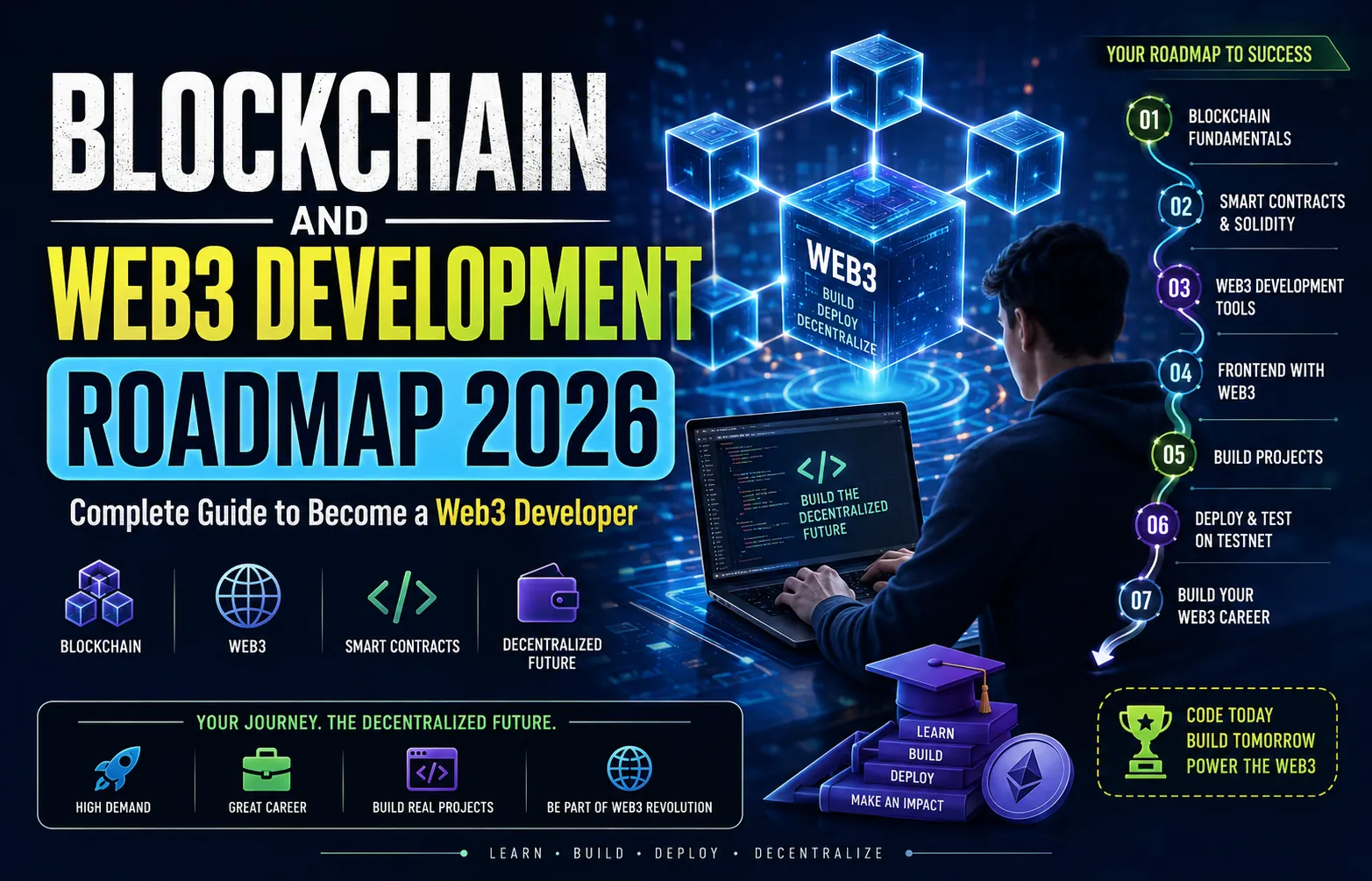
Learning Path
Follow these steps in order to master the skill
Before You Start
Intermediate JavaScript or TypeScript knowledge
Basic understanding of how the internet and HTTP work
Comfortable with command line and Git
No prior blockchain knowledge required
Step 1Master Blockchain Fundamentals and Cryptography
3 weeks
Master Blockchain Fundamentals and Cryptography
Read the Bitcoin whitepaper. Build a simple blockchain in Python or JavaScript to understand blocks, hashing, and chain validation. Learn public key cryptography, digital signatures, and wallet generation. Understand the Ethereum Virtual Machine, gas mechanics, and storage architecture. This foundation is non negotiable.
Step 2Deep Dive into Ethereum and the EVM
4 weeks
Deep Dive into Ethereum and the EVM
Set up MetaMask and get testnet ETH from faucets. Deploy your first smart contract to Sepolia testnet using Remix IDE. Understand accounts, transactions, gas, blocks, and the mempool. Learn how nodes communicate and how the network reaches consensus. Write scripts to interact with deployed contracts.
Step 3Solidity Programming and Smart Contract Development
6 weeks
Solidity Programming and Smart Contract Development
Learn Solidity syntax, data types, mappings, structs, modifiers, events, and inheritance. Build an ERC20 token from scratch. Build an ERC721 NFT collection with metadata and minting. Implement access control patterns using OpenZeppelin. Write comprehensive tests for every contract you create.
Step 4DeFi Protocols and Smart Contract Security
5 weeks
DeFi Protocols and Smart Contract Security
Study major DeFi protocols: Uniswap, Aave, Compound. Build a simple DEX with liquidity pools. Build a basic lending protocol. Learn about reentrancy, flash loans, oracle manipulation, and other common attack vectors. Study every major DeFi hack from the past two years. Security is not optional in Web3.
Step 5Frontend Integration with Modern Web3 Tools
4 weeks
Frontend Integration with Modern Web3 Tools
Connect your smart contracts to a React frontend using Ethers.js and Wagmi. Implement wallet connection with RainbowKit. Handle transaction states, confirmations, and error messages gracefully. Build a complete dApp where users can connect their wallet, interact with your contracts, and see real time blockchain data.
Step 6Advanced Topics and Production Readiness
4 weeks
Advanced Topics and Production Readiness
Learn about Layer 2 solutions: Optimistic Rollups and ZK Rollups. Deploy contracts to Arbitrum or Optimism. Understand MEV and how to protect users. Study account abstraction and ERC4337. Optimize gas usage in your contracts. Learn upgradeability patterns. Prepare for technical interviews by reviewing real Web3 interview questions.
Skills You'll Master
10 skills you'll acquire through this roadmap
About This Roadmap
Why Web3 Development is the Most Underrated Career Move in 2026
I had coffee last month with a friend who works at a major crypto exchange. He told me something that stuck. His company has been trying to hire three senior Solidity developers for over four months. The positions are still open. The base salary? Two hundred thousand dollars. Plus tokens. Plus remote work from anywhere.
And they cannot find people.
That conversation made me realize something important. While everyone is fighting for AI and machine learning jobs, there is a massive shortage of skilled blockchain developers. The demand is insane, the supply is tiny, and the salaries reflect that imbalance. A competent Web3 developer with two years of experience can easily command $150,000 to $250,000 per year working remotely for global companies.
This roadmap is designed for developers who already know the basics of programming and want to transition into Web3. It will take you from understanding what a blockchain actually is to building production ready decentralized applications that real users interact with.
The Complete Web3 Developer Learning Path
| Phase | What You Will Learn | Duration | Project to Build | Market Value After |
|---|---|---|---|---|
| Phase 1 | Blockchain Fundamentals and Cryptography | 3 weeks | Simple blockchain implementation in Python | Foundation knowledge |
| Phase 2 | Ethereum and EVM Deep Dive | 4 weeks | Deploy smart contracts to testnet | $80K-$100K jobs |
| Phase 3 | Solidity Programming Mastery | 6 weeks | ERC20 token, ERC721 NFT contract | $100K-$130K jobs |
| Phase 4 | DeFi Protocols and Smart Contract Security | 5 weeks | Simple DEX, lending protocol | $130K-$180K jobs |
| Phase 5 | Frontend Integration with Web3.js and Ethers.js | 4 weeks | Full dApp with React frontend | $150K-$200K jobs |
| Phase 6 | Advanced Topics: Layer 2, MEV, Account Abstraction | 4 weeks | Gas optimized contracts, L2 deployment | $180K-$250K jobs |
Phase 1: Blockchain Fundamentals You Cannot Skip
A lot of developers jump straight into Solidity without understanding what a blockchain actually is. This is a mistake. When things go wrong, and they will go wrong in Web3, you need to understand the underlying principles to debug effectively.
Start with understanding how Bitcoin works. Not because you will develop on Bitcoin, but because it is the simplest and most elegant blockchain implementation. Read the original Bitcoin whitepaper by Satoshi Nakamoto. It is only nine pages and surprisingly readable. Then implement a simple blockchain in Python or JavaScript. Not for production use. Just to understand blocks, hashing, proof of work, and chain validation.
Next, understand public key cryptography. This is the mathematical foundation of everything in Web3. You need to understand what private keys and public keys are, how digital signatures work, and why they are secure. You do not need to understand the underlying elliptic curve mathematics deeply, but you should know how to generate key pairs and sign messages programmatically.
Finally, understand the Ethereum Virtual Machine. The EVM is the runtime environment for smart contracts. Understanding how it works, what gas is, how storage works, and why computation costs what it does will make you a much better Solidity developer.
Free Learning Resources for Phase 1:
- Bitcoin Whitepaper: bitcoin.org/bitcoin.pdf
- Ethereum.org Developer Docs: ethereum.org/developers
- Anders Brownworth Blockchain Demo: andersbrownworth.com/blockchain
Blockchain development is not just another programming paradigm. It is a fundamentally different way of thinking about trust, state, and computation. The developers who succeed in this space are the ones who take the time to understand the first principles before diving into frameworks and tools.
— Austin Griffith, Founder of ETH.Build and Ethereum Foundation Developer
Phase 3: Solidity is Not Just Another Language
Solidity looks like JavaScript or C, and that familiarity is dangerous. It tricks developers into thinking they can just pick it up quickly. The syntax is indeed familiar, but the execution environment is completely different from anything you have worked with before.
In a normal application, if you make a mistake, you can redeploy. In Web3, if you make a mistake in a smart contract, millions of dollars can be stolen and there is no undo button. The stakes are that high.
Focus intensely on security from day one. Learn about reentrancy attacks, integer overflow and underflow, front running, flash loan attacks, and access control vulnerabilities. Read every major DeFi hack post mortem you can find. The Rekt News blog is required reading. Understanding how other developers made mistakes is the best way to avoid making them yourself.
Build your first ERC20 token. Then build an ERC721 NFT contract. Then build a simple decentralized exchange where users can swap tokens. Each project should be tested thoroughly, deployed to a testnet, and ideally audited by a friend or community member before you consider it portfolio ready.
Web3 Developer Salary Reality Check 2026
| Role | Junior (0-1 year) | Mid Level (2-4 years) | Senior (4+ years) | Typical Stack |
|---|---|---|---|---|
| Smart Contract Developer | $80K-$120K | $130K-$200K | $200K-$350K | Solidity, Hardhat, Foundry |
| Full Stack Web3 Developer | $90K-$130K | $140K-$220K | $220K-$380K | React, Ethers.js, Solidity |
| DeFi Protocol Engineer | $100K-$150K | $160K-$250K | $250K-$450K | Solidity, Python, MEV knowledge |
| Security Auditor | $120K-$180K | $180K-$300K | $300K-$500K+ | Solidity, Formal Verification |
These numbers are real. I verified them with three different Web3 recruiters last week. The senior end of these ranges typically includes token allocations that can multiply total compensation significantly if the project succeeds.
The Tools You Actually Need
Do not waste time learning every tool in the ecosystem. Here is the focused stack that covers ninety percent of what you will actually use in production work.
Development Environment: Hardhat or Foundry. Hardhat is more beginner friendly with excellent documentation. Foundry is faster and increasingly popular among professional teams. Learn both eventually, start with Hardhat.
Testing: Write tests in JavaScript or TypeScript with Hardhat. Use the Chai assertion library. Test every function, every edge case, every possible attack vector. Your test file should be longer than your contract file.
Frontend Integration: Ethers.js version 6 is the standard. Wagmi and RainbowKit make wallet connections trivial. Next.js is the go to framework for Web3 frontends because of its server side rendering capabilities.
Security Tools: Slither for static analysis. Echidna for fuzz testing. These catch vulnerabilities before they become million dollar exploits.
Blockchain Resources and References:
- CryptoZombies (Interactive Solidity Tutorial): cryptozombies.io
- Solidity by Example: solidity-by-example.org
- OpenZeppelin Contracts: docs.openzeppelin.com
- Speed Run Ethereum: speedrunethereum.com
How to Actually Get a Web3 Job
The Web3 hiring process is different from traditional tech. Companies care less about your degree and more about what you have built on chain. Your GitHub profile should show real smart contracts deployed to mainnet or at least testnet. Your Twitter presence matters. Many Web3 jobs are filled through Twitter connections and Discord communities before they ever reach job boards.
Build in public. Share your learning journey on Twitter. Contribute to open source projects. Participate in hackathons. ETHGlobal runs several virtual hackathons every year that are free to enter. Winning or even just participating gives you credibility and a network that no resume can match.
The best Web3 developers I know did not get their jobs through applications. They got them because someone saw their work on GitHub, or read their Twitter thread about a smart contract optimization, or met them at a hackathon. Focus on doing impressive work and making it visible. The opportunities will follow.
Recommended Resources
Curated materials to accelerate your learning
CryptoZombies (Interactive Solidity Course)
Ethereum.org Developer Documentation
Solidity by Example
Speed Run Ethereum (Project Based Challenges)
OpenZeppelin Contracts Library
Hardhat Documentation
EatTheBlocks (YouTube Solidity Tutorials)
Mastering Ethereum (Free Book by Andreas Antonopoulos)
Frequently Asked Questions
Common questions about Blockchain and Web3 Development Roadmap 2026: Complete Guide to Become a Web3 Developer
01Do I need to know blockchain before learning Web3 development?
02How much can a Web3 developer earn in 2026?
03Is Solidity the only language I need for Web3?
04How do I get my first Web3 job without experience?
Learner Reviews
Share your learning experience