
Google's Willow Quantum Chip: A Quantum Leap or the End of Classical Computing?
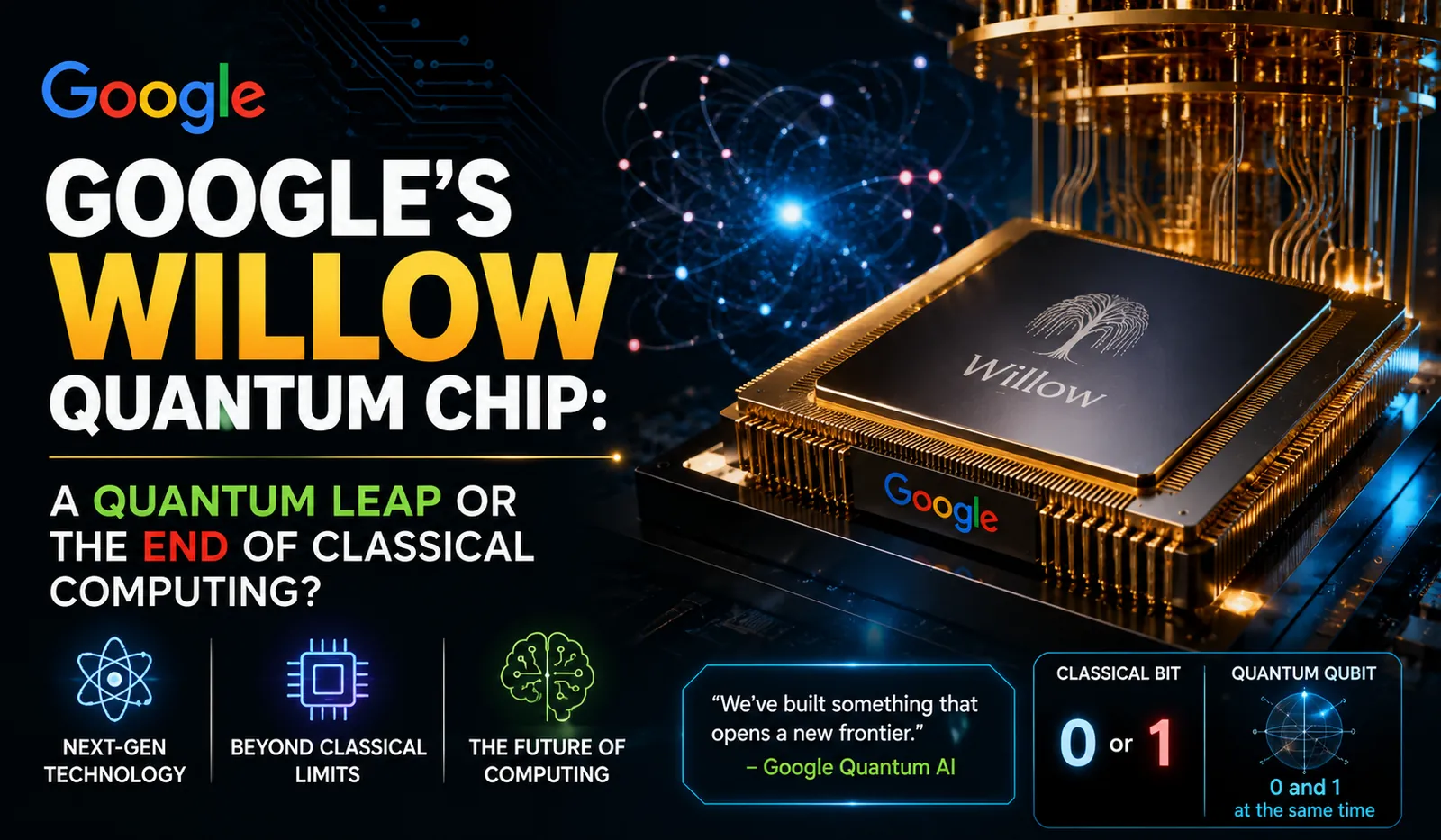
Google's Willow Quantum Chip: A Quantum Leap or the End of Classical Computing?
In December 2024, Google unveiled its latest quantum computing chip Willow sending shockwaves through the technology industry. With claims that it can solve in minutes what would take classical supercomputers billions of years to compute, Willow represents a paradigm shift in computational power. But what exactly is this new chip, and what does it mean for the future of technology?
What Makes Willow Special?
The Willow quantum processor features 105 physical qubits and boasts several groundbreaking capabilities that set it apart from previous quantum computers:
- Exponential Error Reduction: Google claims Willow can reduce errors exponentially as its number of qubits increases a major milestone in quantum computing
- Random Circuit Sampling (RCS): The chip performed a random circuit sampling computation in under five minutes that would take the world's fastest classical supercomputer an estimated 10 septillion years to complete
- Real-Time Error Correction: Willow demonstrated real-time error correction, a critical requirement for building practical, large-scale quantum computers
"Willow marks a milestone in the journey towards building a useful, large-scale quantum computer. This is the point where we can start to seriously think about quantum advantage."
Hartmut Neven, Google Quantum AI Founder
The Quantum Supremacy Debate
While Willow's performance is impressive, the concept of "quantum supremacy" the point where quantum computers definitively outperform classical ones remains debated. Some experts point out that the RCS benchmark, while a significant achievement, may not represent practical usefulness.
Nevertheless, the improvements in error correction are widely considered a game-changer. According to Professor Mikhail Lukin of Harvard, "quantum error correction is the key to making quantum computers practical. Google's achievement here is a massive step forward."
Quantum Timeline: Classical vs. Quantum Computing
| Year | Classical Computing Milestone | Quantum Computing Milestone |
|---|---|---|
| 1940s | First electronic computers (ENIAC) | — |
| 1980s | Personal computers emerge | Feynman proposes quantum computers |
| 2019 | 5G networks, AI breakthroughs | Google's Sycamore achieves quantum supremacy |
| 2024 | AI revolution, edge computing | Google's Willow demonstrates error correction |
| 2026 | Quantum-resistant encryption emerges | Practical quantum applications expected |
Implications for Security and Cryptography
One of the most immediate concerns about the advancement of quantum computing is its impact on encryption. Current cryptographic systems like RSA and ECC rely on the difficulty of factoring large numbers a task that quantum computers, with enough qubits, could perform exponentially faster.
While Willow is not yet powerful enough to break modern encryption, its progress signals that the timeline for quantum-resistant cryptography is accelerating. Governments and corporations are already working on post quantum cryptography standards to prepare for this eventuality.
Google's Commercial Quantum Roadmap
Google aims to build a commercially viable quantum computer by 2030. This would enable applications in drug discovery, materials science, artificial intelligence, and climate modeling. Pharmaceutical companies are already exploring quantum simulations to discover new drug candidates.
Financial institutions are also taking note. "The ability to solve optimization problems that are currently intractable would be a game-changer for portfolio management and risk analysis," says a spokesperson from JPMorgan Chase, which has partnered with quantum computing startups.
Global Race for Quantum Supremacy
| Company/Country | Project | Status | Key Achievement |
|---|---|---|---|
| Willow | ✅ Launched 2024 | 105 qubits, error correction | |
| IBM | Condor | ✅ Launched 2023 | 1,121 qubits |
| China | Jiuzhang | ✅ Launched 2021 | Photonic quantum supremacy |
| Microsoft | Azure Quantum | 🔄 In development | Topological qubits |
| Amazon | Braket | 🔄 In development | Quantum-as-a-Service |
Key Challenges Ahead
- Error Rates: Despite progress, quantum error rates remain a significant hurdle
- Scalability: Building computers with millions of stable qubits is far from reality
- Cost: Quantum computers require ultra-cold temperatures (near absolute zero)
- Skill Gap: Need for thousands of quantum scientists and engineers
Frequently Asked Questions
Q: What is Google's Willow quantum chip?
A: Willow is Google's latest quantum processor featuring 105 qubits. It demonstrated exponential error reduction and performed a calculation in minutes that would take a classical supercomputer billions of years.
Q: Will Willow break encryption?
A: Not yet. Willow is a research prototype. However, its progress signals that post-quantum cryptography is urgently needed.
Q: When will quantum computers become practical?
A: Major companies expect practical quantum computers by 2030, with early commercial applications emerging in the next 2-3 years.
Conclusion
Google's Willow represents a significant milestone in the journey toward practical quantum computing. While full-scale quantum computers remain years away, the progress in error correction and qubit performance is accelerating. The quantum race is well and truly on, and the implications for technology, security, and society are profound.
Subscribe to Our Newsletter
Get the latest insights, trends, and analysis delivered to your inbox weekly. Join thousands of smart readers.
No spam. Unsubscribe anytime. We respect your privacy.