
I Tracked Every Dollar I Spent for 365 Days Straight and Here Are 12 Money Habits That Actually Changed My Life
The Day I Realized I Had No Idea Where My Money Went
December 31, 2024. I was sitting on my couch, looking at my bank balance, and I felt sick. I had earned $72,000 that year. Not a fortune, but solid middle class income. And yet, my savings account had exactly $1,847 in it. That was everything I had managed to save in twelve months of working.
I remember saying out loud to my empty apartment: "Where did it all go?"
The scariest part? I genuinely could not answer that question. Sure, I could account for rent and my car payment. But the other $45,000 or so? No idea. A fog of takeout orders, Amazon purchases, subscription services I had forgotten about, and weekend spending that added up in ways I never tracked.
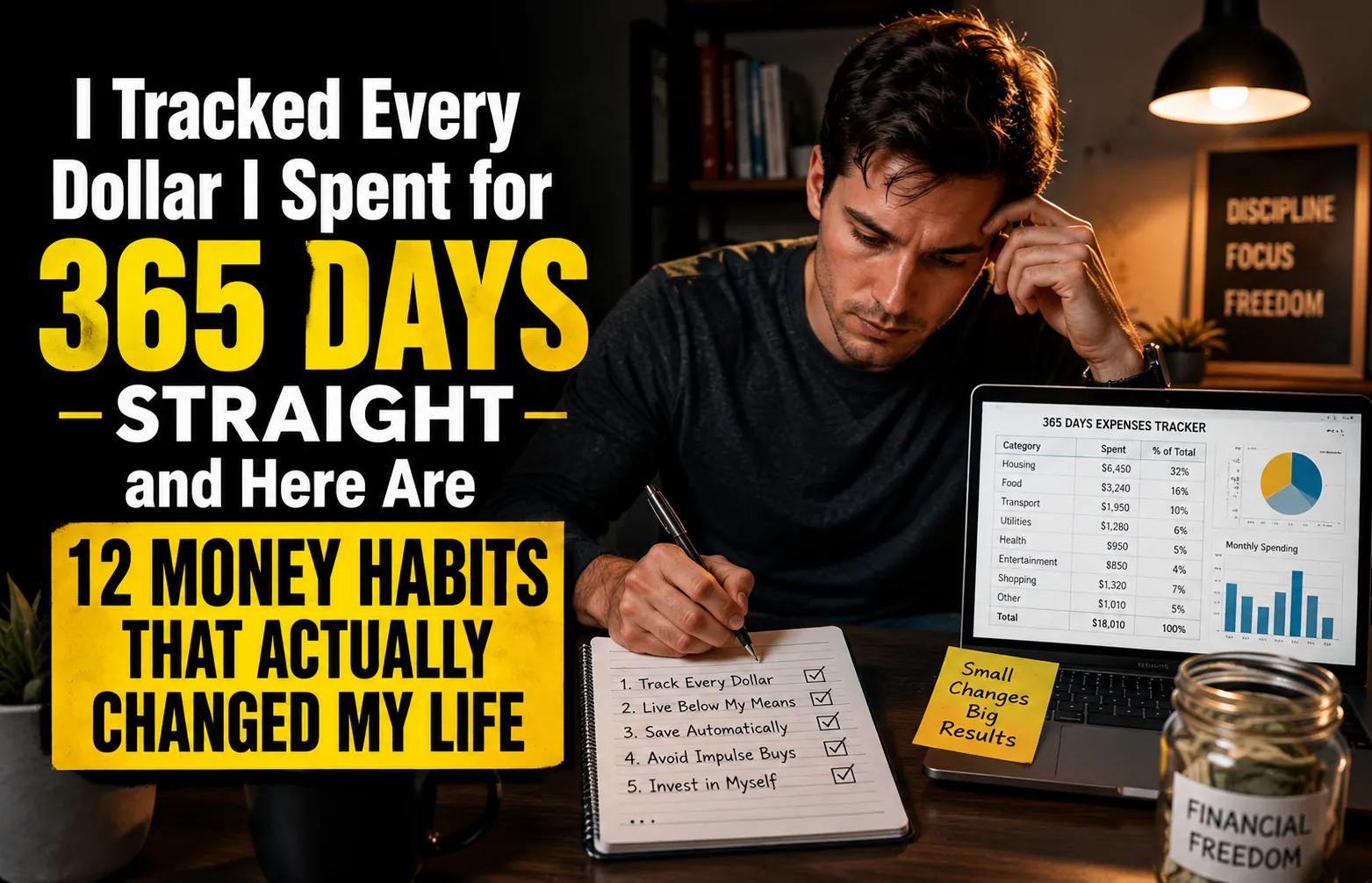
That night, I made a decision that sounds almost comically boring: I would track every single dollar I spent for an entire year. Every coffee. Every gas station snack. Every in app purchase. Every tip at a restaurant. Everything.
What I learned over those 365 days completely changed my relationship with money. I saved $11,400 more than the previous year. I paid off $8,000 in credit card debt. And for the first time in my adult life, I actually felt like I understood where my money was going.
Here are the twelve habits that made the biggest difference.
Habit 1: I Stopped Using the Word "Budget" and Started Saying "Spending Plan"
This sounds like semantics, but it genuinely changed my behavior. The word "budget" feels restrictive. It feels like a diet. Nobody likes diets. But a "spending plan" feels intentional. It feels like you are choosing where your money goes rather than being told where you cannot spend it.
I started telling friends, "I have a spending plan for this month" instead of "I'm on a budget." The psychological shift was immediate. I was not depriving myself. I was making choices.
Habit 2: I Audited Every Single Subscription
On January 2nd, I sat down and went through my credit card statements with a highlighter. I found eleven recurring subscriptions. Eleven. I was actively using exactly four of them. The other seven were draining $127 per month from my account without me even noticing.
Here is what I was paying for without using: a meditation app I opened twice, a premium weather app I downloaded for a hurricane that never came, a second cloud storage service because I forgot I already had one, a language learning app I used for three days in 2023, and three streaming services when I primarily watch one.
I canceled all seven unused subscriptions. That alone saved $1,524 per year. For doing absolutely nothing except paying attention for thirty minutes.
Habit 3: The 48 Hour Rule Changed Everything
I implemented a strict rule: any non essential purchase over $50 required a 48 hour waiting period. Put it in the cart. Close the tab. Wait two full days. If I still wanted it after 48 hours, I could buy it.
Over the course of the year, I put 47 items into various shopping carts. I actually purchased six of them. The other 41 items, once the initial desire faded, seemed completely unnecessary. This single habit saved me roughly $3,200.
The most embarrassing example: a $340 espresso machine that I was absolutely convinced would change my life at 11 PM on a Tuesday. By Thursday morning, I remembered that I do not even like espresso. I like the idea of being someone who makes espresso. Those are very different things.
Habit 4: I Started Cooking One New Recipe Every Sunday
I was spending roughly $620 per month on restaurants and takeout. That is $7,440 per year on food that I mostly did not even enjoy that much. It was convenience eating. Exhausted after work, too tired to cook, tap tap tap on DoorDash.
I am not a natural cook. I burned rice once. I did not know that was possible. But I decided to learn one new recipe every Sunday. Nothing complicated. Pasta dishes. Stir fries. Sheet pan meals where you literally just throw vegetables on a tray and put them in the oven.
By March, I had ten recipes I could make without thinking. By June, I actually looked forward to cooking. My monthly food spending dropped from $620 to about $280. And the food was better. I am not being dramatic when I say that learning to cook was the single highest return skill I have ever invested in.
Habit 5: I Automated Everything
On the first of every month, $400 moves from my checking account to a high yield savings account. I set this up once in January and never touched it again. By December, I had $4,800 saved without ever making a conscious decision to save.
Automation works because it removes willpower from the equation. You cannot spend money that is not in your checking account. It is that simple. The money moves before you even see it.
Habit 6: I Learned to Say "That's Not in My Spending Plan Right Now"
This was the hardest habit to develop. Social pressure is real. When friends want to go to an expensive restaurant, or coworkers are ordering lunch from somewhere pricey, or someone suggests a weekend trip that sounds fun but costs $400, saying no feels awkward.
What worked for me was having a phrase ready. I practiced saying "That sounds great, but it's not in my spending plan this month. Rain check?" Nobody ever pushed back. Most people actually seemed relieved, like I had given them permission to also not spend money they did not want to spend.
Habit 7: I Started Tracking Net Worth, Not Just Spending
About three months in, I realized I was only looking at the negative side: what I was spending. I started tracking my net worth too. Every month, I would add up my savings, my investments, and subtract my debts.
Watching that number go up, even by small amounts, was incredibly motivating. It turned money management from a chore into a game. In January, my net worth was negative $12,400 due to student loans and credit card debt. By December, it was negative $2,100. Still negative, but moving fast in the right direction.
My Real Numbers: Before and After
| Category | 2024 (Before Tracking) | 2025 (After Tracking) | Annual Difference |
|---|---|---|---|
| Dining Out / Takeout | $7,440 | $3,360 | -$4,080 |
| Subscriptions | $2,160 | $636 | -$1,524 |
| Impulse Purchases | $4,800 (estimated) | $1,600 | -$3,200 |
| Coffee Shops | $1,820 | $520 | -$1,300 |
| Groceries | $3,600 | $4,200 | +$600 |
| Total Savings | $1,847 | $13,247 | +$11,400 |
The increase in grocery spending was intentional. I was buying better ingredients to cook at home. Even with that increase, I still saved over $4,000 on food overall because I was not ordering takeout anymore.
What I Did Not Expect to Learn
The biggest surprise of this entire experiment was not financial. It was emotional. Before I started tracking, money felt like this constant low grade anxiety. I was always slightly worried about it. Not panicked, but unsettled. Like a background hum of stress that never went away.
Tracking changed that. Even on months when I spent more than I wanted to, I knew exactly where the money went. There was no mystery. No guilt about unknown spending. Just clarity. And clarity, it turns out, is the antidote to financial anxiety.
If you take one thing from this article, let it be this: track your spending for thirty days. Not forever. Not as a lifestyle change. Just thirty days. You will learn things about yourself that will surprise you. And that knowledge, more than any budgeting app or investment strategy, is what actually leads to lasting change.